Safety pipeline
Humanoid Control's safety layer is layered rather than concentrated.
Several mechanisms each enforce one piece of the contract: a controller
that produces a bad command is automatically swapped to a compliant
fallback by ros2_control itself, and transport-level faults are surfaced
as telemetry so the operator (or a supervising client) can react. There is
deliberately no single node that watches everything and forces a mode —
the model mirrors the minimal ros2_control reference.
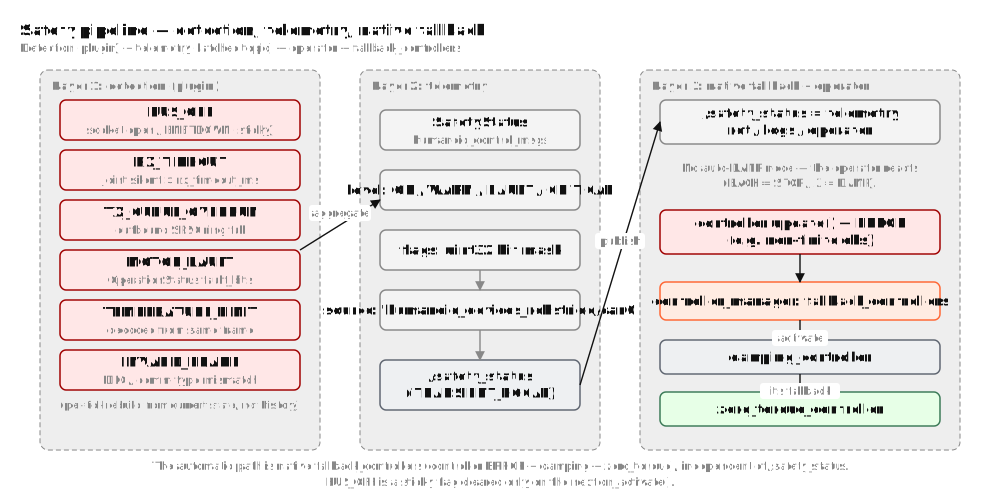
Layer 1 — Hardware plugins detect transport faults
RobstrideSystem, SitoSystem, and the EtherCAT plugin observe
transport-level conditions at every read() tick:
| Condition | Detection |
|---|---|
BUS_OFF | The kernel CAN socket couldn't be opened, or returned ENETDOWN. Sticky — set in on_configure, only cleared on the next on_activate. |
RX_TIMEOUT | One or more joints haven't reported an OperationStatus frame in > rx_timeout_ms (default 200 ms ≈ 10 ticks at 50 Hz). |
TX_QUEUE_OVERRUN | The bus library's outbound SPSC ring overflowed (RT producer faster than the I/O thread can drain to the kernel). |
MOTOR_FAULT | A Robstride status / fault-report frame indicated a non-OK motor state. |
TEMPERATURE_LIMIT | A specific overtemperature bit was set in a motor's fault frame. |
INVALID_FRAME | A frame on the bus had the wrong comm-type code or DLC for the protocol. |
The plugin publishes humanoid_control_msgs/SafetyStatus on /safety_status —
TRANSIENT_LOCAL durability so late-joining subscribers (rqt, an operator
dashboard) immediately see the most recent value. The source field
carries the bus interface name
(humanoid_devices_robstride/can0, etc.), so an operator can tell which bus
flagged.
Each tick, the plugin rebuilds flags from currently observed
conditions, not accumulated history. The exception is BUS_OFF —
which can't self-recover without a configure round-trip — which
sticks until activate. That choice avoids two bad failure modes:
- No-sticky-anywhere: a single EMI glitch would condemn the robot to FAULT for the rest of the activation.
- Sticky-everywhere: even transient drops would require an operator reset to clear, masking when the bus is actually healthy now.
Per-bit publish only happens on change, so the topic stays quiet (level=0, flags=0) for a healthy robot and emits exactly one message per state transition.
Layer 2 — Controllers validate their own commands
The hardware plugins are not the only ones who can refuse to do
something. Each controller's update() returns a
controller_interface::return_type that the controller_manager
inspects:
| Controller | Reason it might return ERROR |
|---|---|
RLPolicyController | NaN / non-finite observation, wrong tensor size, action outside configured limits |
RemotePolicyController | MITCommand joint_names don't match claimed order, array length mismatch, stale command (configurable policy) |
StandbyController | pose_segment_N malformed (caught at on_configure, not update) |
A non-OK return_type triggers the controller_manager's
fallback_controllers mechanism — see Layer 3.
RemotePolicyController — the System 1/2 external-command ingress —
additionally has a stale-command policy: if the external source's
MITCommand hasn't arrived within stale_command_timeout_ms
(default 100 ms = 5 ticks at 50 Hz, measured against arrival time at the
subscription callback — not against MITCommand.header.stamp — so
publisher clock skew is irrelevant), the controller writes a fallback
pattern rather than re-using the last command. Default passive → a
damped hold: zero stiffness, high damping (kD = damping_scalar,
default 6.0, matching DAMPING mode), holding the live joint position — the
arms stay damped, not limp. (The same damped hold also applies when REMOTE
is first entered, before any MITCommand has arrived.) Alternative hold
→ freeze at the last commanded pose. Either way the controller stays alive
and active; the choice is whether to "fail compliant" or "fail rigid".
RLPolicyController has no such command stream — it runs inference
in-process (System 0), so there is nothing to go stale. It guards
against bad output instead: a NaN / non-finite action returns
ERROR and falls through to Layer 3.
Layer 3 — controller_manager's fallback_controllers
Every active-policy controller is configured with
fallback_controllers: [damping_controller] in
humanoid_control_lite_controllers.yaml. The controller_manager interprets this
as "if this controller returns ERROR, automatically deactivate it
and activate the fallback".
The hierarchy is conservative to most-conservative:
RLPolicyController     → damping_controller
RemotePolicyController → damping_controller
StandbyController      → damping_controller
DampingController      → zero_torque_controller
ZeroTorqueController   → (no fallback — final fall-back)
zero_torque_controller is the unique safer-than-damping option,
reserved for cases where DAMPING itself can't be applied (state
interface unavailable, hardware plugin dead). It writes 0 to every
interface — no risk of unintended motion regardless of state.
Layer 4 — /safety_status is operator telemetry
There is deliberately no automatic /safety_status → DAMP path. The
old mode_manager node subscribed to /safety_status and forced a STRICT
switch to DAMPING on any non-OK level; that node is deleted, and nothing
replaced its auto-DAMP behavior.
Instead, /safety_status is telemetry. Bus and motor faults
(RX_TIMEOUT, MOTOR_FAULT, TEMPERATURE_LIMIT, BUS_OFF, and the rest)
are published for a human operator — or a supervising client — to see and
react to: press X to DAMP or BACK to STOP. What is automatic is
Layer 3: a controller that turns a fault into a bad command (a non-finite
observation, say) returns ERROR, and the controller_manager activates its
fallback_controllers with no operator in the loop.
This is a deliberate reduction to the reference's minimal model. The two automatic guarantees that remain — a controller catching its own bad command (Layer 2) and the controller_manager swapping in the fallback (Layer 3) — cover the case that actually needs sub-tick reaction. Reacting to a reported bus fault is left to the operator, who can always DAMP or STOP from the gamepad.
Layer 5 — RT update() discipline
A subtler "safety" layer that's worth naming: the RT update() paths
follow the standard RT-safety rules.
- No allocations on the tick. Every controller / hardware plugin
pre-allocates buffers in
on_init/on_configure. Therealtime_tools::RealtimeBufferandrealtime_tools::RealtimePublisherprimitives are the path for any RT-to-non-RT data movement. - No DDS-blocking calls. Publishers go through
RealtimePublisher'strylockpattern — drop the message if the non-RT thread is mid-publish, rather than blocking the tick. - No exceptions across the RT boundary. A throw inside
update()would unwind into the controller_manager's RT thread, which is generally not safe under PREEMPT_RT. - No logging at tick rate. Use
RCLCPP_*_THROTTLEor buffer the message into a non-RT publisher.
Violating these doesn't (directly) cause a safety incident, but it causes scheduler jitter that can make the higher layers slow to react — RX_TIMEOUT trips spuriously because the read thread missed its slot, etc.
Summary
| Layer | Owner | Triggers |
|---|---|---|
| 1. Transport-level | hardware plugin | Bus / motor faults → SafetyStatus.flags |
| 2. Command-validity | controller | NaN / size mismatch / stale → return_type::ERROR |
| 3. Controller-manager fallback | controller_manager | ERROR → activate the controller's fallback_controllers |
| 4. Fault telemetry | /safety_status subscribers | Bus / motor faults reported for the operator (or a client) to react — no automatic DAMP |
| 5. RT discipline | every controller / plugin | (preventative — keeps the other layers responsive) |
See also
- How-to → Recover from a fault — operator-side runbook.
- Reference → Messages → SafetyStatus — full bit table.
- Five-mode FSM — the modes and flat
joy_teleopswitching.